

Lap welds are a common type of weld used in various industries, including automotive, aerospace, and manufacturing. They are created by overlapping two pieces of metal and welding them together along the overlapping edges. The quality of lap welds is crucial as it directly affects the strength, durability, and overall performance of the welded structure. In recent years, the use of Collaborative Robot (Cobot) Welding Cells has emerged as a game - changer in improving the quality of lap welds. As a Cobot Welding Cell supplier, I'm excited to share insights on how these innovative systems enhance lap weld quality.
Precision and Consistency
One of the most significant advantages of a Cobot Welding Cell is its ability to provide high - precision and consistent welding. Traditional manual welding often relies on the skill and experience of the welder, which can lead to variations in weld quality. Even the most experienced welders may experience fatigue, resulting in inconsistent bead width, penetration, and fusion.
Cobot Welding Cells, on the other hand, are programmed to execute welding operations with extreme precision. They can precisely control the welding parameters such as welding speed, current, voltage, and wire feed rate. For lap welds, this precision is essential. The cobot can ensure that the weld bead is of uniform width and height along the entire length of the lap joint. This consistency in the weld bead geometry leads to a more uniform distribution of stress in the welded structure, enhancing its strength and reliability.
For example, in an automotive manufacturing setting where lap welds are used to join body panels, a Cobot Welding Cell can produce welds with a consistent penetration depth. This ensures that the panels are securely joined, reducing the risk of separation or failure during the vehicle's operation.
Real - Time Monitoring and Adjustment
Modern Cobot Welding Cells are equipped with advanced sensors and monitoring systems. These sensors can continuously monitor various welding parameters and the quality of the weld in real - time. For lap welds, sensors can detect issues such as improper fusion, lack of penetration, or excessive spatter.
When a problem is detected, the cobot can make immediate adjustments to the welding parameters. For instance, if the sensor detects that the penetration is too shallow, the cobot can increase the welding current or decrease the welding speed to ensure proper fusion between the overlapping metal sheets. This real - time adjustment capability helps to prevent defective welds and ensures that the quality of lap welds meets the required standards.
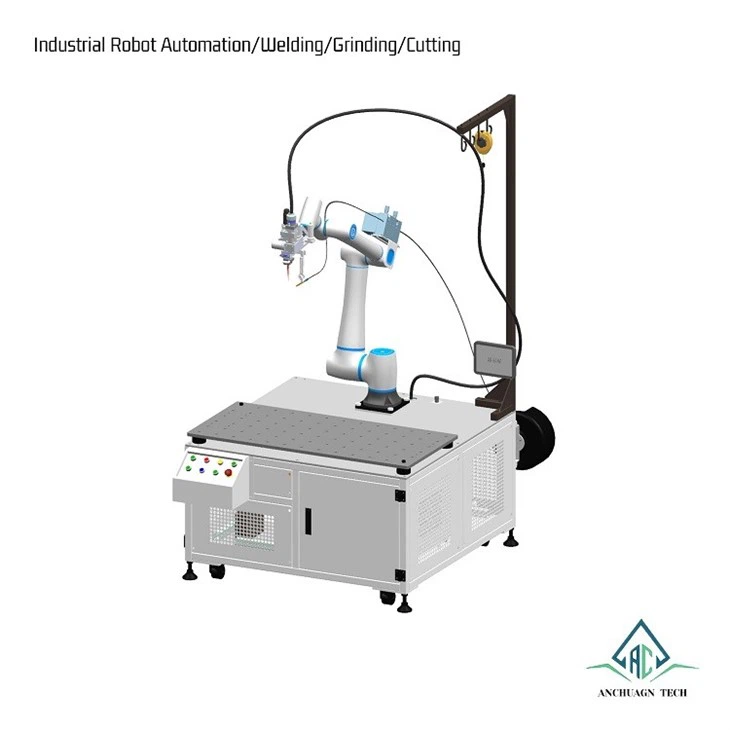
Our Cobot Platform Laser Welding Unit is a prime example of a system that incorporates real - time monitoring. It uses optical sensors to monitor the laser welding process, allowing for quick corrections and high - quality lap welds.
Enhanced Weld Joint Accessibility
In some cases, lap joints can be difficult to access manually, especially in complex or hard - to - reach areas. Manual welders may have limited visibility and maneuverability, which can lead to incomplete or improper welds.
Cobot Welding Cells are designed to overcome these challenges. The collaborative robots in these cells can be easily programmed to reach tight spaces and perform welds at various angles. They can also be equipped with specialized welding torches or end - effectors that are optimized for lap welds. This enhanced accessibility ensures that the entire lap joint is properly welded, eliminating areas of weak or insufficient fusion.
For example, in the aerospace industry, where lap welds are used in the construction of aircraft components, the Cobot Mobile Welding Machine Tool can be deployed to access confined areas within the aircraft structure. The cobot can navigate around complex geometries and perform precise lap welds, ensuring the structural integrity of the components.
Improved Weld Quality through Welding Process Optimization
Cobot Welding Cells offer the possibility of optimizing the welding process for lap welds. Through the use of advanced software, the welding parameters can be fine - tuned based on the specific characteristics of the materials being welded, the thickness of the metal sheets, and the design of the lap joint.
For different types of materials, such as steel, aluminum, or stainless steel, the optimum welding parameters can vary significantly. A Cobot Welding Cell can be programmed to select the appropriate welding process, such as Gas Metal Arc Welding (GMAW), Gas Tungsten Arc Welding (GTAW), or Laser Welding, based on the material properties. This optimization of the welding process leads to better weld quality, including reduced porosity, improved fusion, and enhanced mechanical properties of the lap weld.
Our Mobile Collaborative Welding Robot is capable of adapting to different welding processes and materials, allowing for highly optimized lap welds.

Training and Operator Support
Even though Cobot Welding Cells are automated systems, they still require human operators for supervision and maintenance. However, the learning curve for operating these cells is relatively short compared to traditional welding equipment.
Cobot manufacturers provide comprehensive training programs for operators. These programs cover topics such as programming the cobot, setting up the welding parameters, and troubleshooting common issues. By having well - trained operators, the quality of lap welds can be further improved.
Operators can also work in collaboration with the cobots. The cobot can perform the repetitive and precise welding tasks, while the operator can focus on tasks such as inspecting the welds, loading and unloading the workpieces, and making adjustments as needed. This human - robot collaboration ensures that any potential issues with the lap welds can be quickly addressed, leading to higher - quality welds.
Cost - Effectiveness and Quality
In the long run, using a Cobot Welding Cell can be cost - effective while improving the quality of lap welds. Although the initial investment in a Cobot Welding Cell may be higher than traditional welding equipment, the benefits in terms of reduced waste, increased productivity, and improved weld quality outweigh the costs.
With a Cobot Welding Cell, the number of defective lap welds is significantly reduced. This means less rework and scrap, saving both time and materials. Additionally, the increased productivity due to the high - speed and consistent welding capabilities of the cobot can lead to higher throughput.
The improved quality of lap welds also means that the welded products are more reliable and have a longer service life. This can enhance the reputation of the manufacturing company and lead to increased customer satisfaction and loyalty.
Contact Us for Procurement
If you are interested in improving the quality of your lap welds with our state - of - the - art Cobot Welding Cells, we invite you to contact us for procurement discussions. Our team of experts is ready to assist you in selecting the right Cobot Welding Cell solution for your specific needs, whether it's the Cobot Platform Laser Welding Unit, Cobot Mobile Welding Machine Tool, or Mobile Collaborative Welding Robot. We can provide detailed information on product specifications, pricing, and implementation.
References
- American Welding Society. (2022). Welding Handbook, Volume 1: Welding Science and Technology.
- Groover, M. P. (2017). Fundamentals of Modern Manufacturing: Materials, Processes, and Systems.
- Robotics Industries Association. (2023). Collaborative Robots in Manufacturing: Trends and Applications.
