



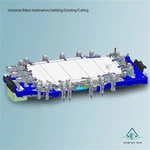
Cutting Robot
Why Choose Us
Product Application
Our products are mainly used for the welding, grinding, and cutting needs of various fields, including automobiles and auto parts, aerospace, ships, petrochemicals, pipelines and pressure vessels, engineering machinery, mining equipment, two and three-wheel vehicle manufacturing, sheet metal, sports equipment manufacturing, medical device manufacturing, metal furniture manufacturing, and rail transit.
Our Company
Changzhou Anchuang Intelligent Equipment Co., Ltd. is an intelligent equipment industry and trade integration company focusing on the application of industrial robot automated welding, grinding, and cutting technologies. The company provides customers with the most professional R&D, production, sales, training, and after-sales services. The headquarters is located in Changzhou, Jiangsu, China. The company’s mission is to provide efficient, accurate, and reliable robotic solutions for the manufacturing industry, and truly realize the automated and intelligent upgrade of manufacturing for global customers.
Our Services
We provide professional consulting services: Anchuang offers customers information consultation on products, prices, technologies, and industry solutions through the Internet, telephone, email, and door-to-door services.
Our Certificates
Our certifications include high-tech enterprise certificates, high-tech product certification certificates, quality management system certification certificates, corporate credit evaluation certificates, industry-university-research-school-enterprise cooperation certificates, patent certificates, and more.
What is a Cutting Robot?
Cutting robots automate the process of removing material from workpieces in order to shape or divide them. Cutting applications are critical for preparing parts for additional production steps or for determining the design of a part. It is crucial cuts are accurate, even, and consistent.


Automotive and Aerospace
Manufacturing cars and aircraft requires intricate components that are difficult to make using traditional means. That’s why multi-axis laser cutting robots are used in such industries for better accuracy, streamlined production, and continuous innovation.
Medical Industry
Medical equipment manufacturing requires extreme precision, which is easily achieved by multi-axes laser cutters.
Electronics
Electronics like PCBs and semiconductors require machining at a very small scale, so it’s hard to achieve a high level of control using mechanical cutters. That’s why laser-cutting robots are prevalent in this industry.
Industries Requiring Multiple Tasks
Laser-cutting robots can also be modified by replacing the laser cutting head to perform laser welding, cleaning, and marking. Such a high level of flexibility makes it an extremely economical and versatile machine for any industry.
Common Robot Types Used For Cutting Robot
Articulated Robots
An articulated robot is an industrial robot that mimics the movement of a human arm. It consists of an arm attached to a base with a twisting joint. This arm can have anywhere from two to ten rotary joints, similar to pivot points. These joints, or axes, allow the robot to move in different directions, like our elbow, wrist, and shoulder joints. Articulated robots mostly have either four or six axes, providing them with a wide range of motion.
Cartesian Robots
Cartesian robots, also known as linear or gantry robots, are common types of industrial robots. They operate by moving along three straight-line axes: X (side to side), Y (back and forth), and Z (up and down). Some versions can move in up to six directions in total. Cartesian robots often come with cameras and sensors to measure distances and identify objects.
Cylindrical Robots
A cylindrical robot is an industrial robot with a unique structure. At its base, it has a rotary joint. Connected to this is an arm with a prismatic joint, which means it can move up and down, like a telescope. This design gives the robot three ways to move: two in straight lines and one in a circular path. The circular part allows it to rotate its arm 360°, enabling both circular and straight movements on a horizontal plane. It can also move up and down and rotate around the same axis.
Delta Robots
A delta robot is easy to spot because it looks like an upside-down triangle, with a mobile platform and three arms joined by spherical joints. Like the Cartesian robot, the arms of the delta robot can move in three directions: side to side (X), back and forth (Y), and up and down (Z), the latter of which they're especially good at. Delta robots are flexible and cover a wide working area in a dome-like shape. They can handle delicate tasks with precision at high speeds because all three arms directly control the end part.
SCARA Robots
A Selective Compliance Assembly Robot Arm (SCARA) is an industrial robot used in multiple industrial applications. These robots have articulated arms and rotating joints on horizontal axes. They excel at performing fast and precise movements on a horizontal plane and can also work vertically, although with some limitations.
Polar Robots
Polar robots, often referred to as spherical robots, are among the most versatile industrial machines available. They're used not only on production lines but also in research and development fields, such as robotics, artificial intelligence, and biomechanics. These robots have a fixed base and offer three degrees of freedom, enabling movement along the X, Y, and Z axes. Additionally, they feature an extendable articulated arm that provides flexibility in reaching and maneuvering.
Collaborative Robots
Collaborative robots, often called cobots, are a type of industrial robot that shares its workspace with humans. Unlike traditional robots, cobots are designed to prioritize worker safety. They use sensors to monitor their surroundings, especially when humans are nearby. Cobots employ advanced force, proximity, and vision sensors to detect and respond to human presence.
Increased Efficiency & Productivity:
An industrial robot is equipped with joints like a human arm, moves quickly, and never gets tired. It works 24/7, speeding up your work without any breaks.
Improved Quality & Consistency:
With its flexible, jointed arm, industrial robots handle tasks with a level of precision humans can only dream of. This means every product it touches turns out exactly the same, ensuring top-notch quality every time.
Enhanced Safety:
Industrial robots take on risky jobs, keeping you and your team out of harm’s way. Safety first, always. These robots can handle dangerous tasks – working with hot metals, toxic substances, or heavy lifting – that could put you or your coworkers at risk. By stepping in to do these tasks, they significantly reduce the chance of accidents and injuries.
Reduced Operating Costs:
Industrial robots are the heavy lifters that never call in sick or take a break, tirelessly working shifts. These robots don’t just replace one aspect of the production process; they can take on multiple tasks. This versatility means you can save on additional machinery and the space it would occupy. Plus, their precision reduces waste materials, saving you even more money.

Best Features of Cutting Robot
Technological advantages- Robot technology is advancing significantly and robotic laser cutting machines are not exceptions. They are capable of pushing automobile industry forward. One can get high speed with accuracy and repeatability of expensive CNC laser cutting machines but without a high cost, high and low flexibility which is the main drawback of CNC laser cutting machines.
Robotic laser cutters are power savers and can cut any material - A traditional cutter consumes minimum 50 kW power in total, but robotic laser cutting machines consume very low power. Also, robotic laser cutting machines can cut any strength of material provided the melting point of the material is low.
They are safe - In traditional cutting machines large blades move up and down with very high speed and don’t have safety features. One’s hand can be easily get caught in it. While robotic laser cutters do not require human beings to operate it. Hence, there is no possibility of anyone to get injured.
Flexible to operate - One need to invest a heavy amount on traditional cutters as they have different shaped tools required to be fitted in specifically designed parts. If you wish to make a change in any dimension, it is not possible. You have to buy a new tool and replace the previous one with it. Though the tools are not that much expensive, their maintenance cost is high because it has to be done by an expert on a regular basis. On the other hand, robotic laser cutting machines do not require physical maintenance. The changes can be made in dimensions by simply reprogramming it which requires very less time and the expenses are also very low.
Cutting capability - Most modern, this means that Robotic laser cutters can achieve very high precision and can cut at exceptionally high speed. Due to this property, robotic laser cutting is very useful for any type of cutting which needs more accuracy or which is more complex. Also, they can cut thicker materials and are most efficient cutters amongst traditional laser, plasma, oxyfuel and robotic laser cutting.
1.Preparation before cutting
1. Before use, first carefully check the performance of the equipment to ensure that every component is intact.
2. Conduct a detailed inspection of the switch of the power switch, the tightness of the saw blade, the saw blade guard or the safety baffle to ensure the stability of the operating platform. If working at night, there must be sufficient lighting brightness.
3. Before use, turn on the switch. Do not cut the object directly. Instead, test it for a few turns without load, and then start it after confirming that it is safe and correct.
4. Make sure the power supply is consistent with the conventional rated 220VA voltage on the power tool, and do not connect it to a 380VA power supply by mistake.
2.Precautions when cutting
1. When working with the cutting machine, you must concentrate, be clear-headed, and operate the power tool in a compliant manner. Never operate the cutting machine if you are tired, drunk, taking stimulants or medications.
2. It is strictly prohibited to pull electric wires without permission. Ensure that the power lines are safe and reliable. The power lines must be placed in compliance with regulations. Before using the cutting machine, carefully check the performance of the equipment to ensure that every component is intact.
3. Work clothes should fit well and should not be too loose or too tight. Do not wear jewelry or have long hair. It is strictly forbidden to wear gloves or operate without cuffs buttoned.
4. During processing, the workpiece must be firmly clamped. When the workpiece is not clamped tightly, cutting operations are prohibited.
5. It is forbidden to grind the workpiece burrs on the grinding wheel plane to prevent the grinding wheel from breaking and injuring people.
6. When cutting, the operator should deviate from the front of the grinding wheel and wear protective glasses during operation. Dust will be caused during operation, so wear a mask or face shield.
7. It is strictly forbidden to use incomplete grinding wheels. When cutting, you should prevent sparks from flying around and keep away from flammable and explosive items.
8. When clamping the workpiece, the clamping must be stable and firm, and the protective cover must be installed correctly. After clamping, start the machine and run it dry for inspection. If there is jitter or abnormal noise, stop the inspection immediately.
9. If you replace the cutting blade with a new one, do not tighten the locking nut too hard to prevent the saw blade or grinding wheel from cracking and causing an accident.
10. When cutting, hold the handle of the cutting machine firmly, apply force evenly, and cut vertically.
11. When cutting, be careful not to cut small workpieces that are not clamped, and do not cut profiles with serious edges.
12. Sometimes in order to improve work efficiency, multiple saws are cut together. At this time, auxiliary clamping and positioning work must be done.
13. Do not use powerful cutting saws. Before cutting, the motor speed must reach full speed before operation.
14. When cutting, do not stand behind the saw. When taking a break or leaving the work place, cut off the power supply immediately.
15. Do not release your hand or lift your arm from the saw or workpiece as long as the saw blade is not stopped.
16. If the guard is not in place, no operation is allowed and hands cannot be placed within 15 cm from the saw blade. It is best to keep your body at an angle of 45 degrees during operation, and do not lean over or around the saw.
17. If abnormal sounds occur during work, stop checking immediately. If maintenance or replacement of accessories is required, the power must be cut off and the saw blade must be completely stopped before operation can continue.
18. If you use the cutting machine in a wet place, you need to stand on an insulating mat or a dry wooden board.
19. Turn off the power immediately after processing is completed, and clean the equipment and surrounding areas at the same time.
Certifications

It is an intelligent equipment industry and trade integration company focusing on the application of industrial robot automated welding/grinding/cutting technologies. The company provides customers with the most professional R&D, production, sales, training and after-sales services. The headquarters is located in Changzhou, Jiangsu, China. The company's mission is to provide efficient, accurate and reliable robotic solutions for the manufacturing industry, and truly realize the automated and intelligent upgrade of manufacturing for global customers.
FAQ
Q: What is a Cutting Robot?
Q: How does the laser cutter work?
Q: What factors affect the precision of laser cutting machine?
Q: What is the use of cutting robot?
Automotive Manufacturing: For cutting metal components, textiles for interiors, and precision trimming of parts.
Aerospace: Used in the cutting and shaping of composite materials and metals for aircraft components.
Q: What is the main advantage of using a robotic cutting system?
Q: How do robots cut costs?
Q: What is the definition of a robot?
Q: What are the 7 types of robots?
Q: What is the main advantage of using a robotic cutting system?
Q: How does a Cutting Robot Work?
Q: What Materials can be Cut with a Cutting Robot?
Q: What are the Advantages of Using a Cutting Robot?
Q: Are Cutting Robots Safe to Use?
Q: How Much Does a Cutting Robot Cost?
Q: How low can robot mowers cut?
Q: How noisy are robot mowers?
Q: Can robot mowers work at night?
Q: What is the definition of a robot?
Q: What are the 7 types of robots?
Q: Who is the first robot in the world?