



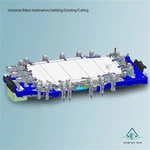
Automated Production Line
Why Choose Us
Product Application
Our products are mainly used for the welding, grinding, and cutting needs of various fields, including automobiles and auto parts, aerospace, ships, petrochemicals, pipelines and pressure vessels, engineering machinery, mining equipment, two and three-wheel vehicle manufacturing, sheet metal, sports equipment manufacturing, medical device manufacturing, metal furniture manufacturing, and rail transit.
Our Company
Changzhou Anchuang Intelligent Equipment Co., Ltd. is an intelligent equipment industry and trade integration company focusing on the application of industrial robot automated welding, grinding, and cutting technologies. The company provides customers with the most professional R&D, production, sales, training, and after-sales services. The headquarters is located in Changzhou, Jiangsu, China. The company’s mission is to provide efficient, accurate, and reliable robotic solutions for the manufacturing industry, and truly realize the automated and intelligent upgrade of manufacturing for global customers.
Our Services
We provide professional consulting services: Anchuang offers customers information consultation on products, prices, technologies, and industry solutions through the Internet, telephone, email, and door-to-door services.
Our Certificates
Our certifications include high-tech enterprise certificates, high-tech product certification certificates, quality management system certification certificates, corporate credit evaluation certificates, industry-university-research-school-enterprise cooperation certificates, patent certificates, and more.
What is Automated Production Line?
Automated production line refers to the route that products pass through during the production process, that is, the route composed of multiple production activities, such as processing, transportation, assembly and control from raw materials to the production site.


Features of Automated Production Line
Automation: minimizing or even eliminating human intervention to lower labor costs, minimize human errors, and allow our valuable human resources to perform more fruitful tasks.
Efficiency: automatic production lines use fewer materials and consume less energy than traditional manufacturing methods. This can translate into reduced costs and increased profits for manufacturers.
Flexibility: when designed properly, automatic production lines can be easily modified to produce a variety of products because the machines (and even robots) used in the system are not limited to a single task.
Consistency: Automatic production lines minimize and even eliminate human errors and inconsistencies, allowing them to produce products with consistent quality.
Safety: by minimizing human intervention, automatic production lines can reduce the risk of accidents caused by human errors, improving workplace safety.
Greater Return on Investment: Automation solutions are tailored to your specific needs and goals, and they quickly pay for themselves through lower operating costs, shorter lead times, increased output, and other benefits.
Operation Principles of Automated Production Lines
Tasks are performed in a specific sequence, with each stage of production dependent on the completion of the previous one. This ensures a smooth flow of materials and products through the line.
All components of the production line are synchronized to operate in harmony. Timing is critical, as any delay in one part of the system can affect the entire production line.
Real-time data from sensors is used to monitor the performance of the production line. Feedback control systems adjust operations based on this data to maintain optimal performance and address any deviations immediately.
Production lines are often designed with modular components that can be easily replaced or reconfigured. This allows for flexibility in responding to changes in production requirements or maintenance needs.
Market Trends Impacting the Automatic Production Line Market
Adoption of industry technologies such as IoT, AI, and robotics to increase automation and efficiency.
Shift towards flexible and modular production lines to accommodate changing consumer demands.
Emphasis on sustainability and eco-friendly practices in production processes.
Integration of data analytics and predictive maintenance for proactive decision-making and maintenance scheduling.
Increased focus on customization and personalization to meet individual consumer preferences.
Tips For Reducing Downtime On Automated Production Line
One of the main reasons it takes so long for the equipment to be back in operations is the lack of repair contractors. As the line technician, knowing and familiarizing with local repair experts means that your plant will be repaired immediately and will be back in operations. You will also save money because local contractors do not have to travel to your facility.
With well-oiled communication between line supervisors and line employees, manufacturing downtime will significantly be reduced. Supervisors need to communicate to their employees the impact of manufacturing downtime and corporate profits. Everything should be efficiently communicated so that other workers around the plant can understand their roles in making sure that the equipment is always operating.
Regular equipment maintenance is an essential strategy of not only reducing but eliminating downtime in a manufacturing organization. Oiling, greasing, tightening nuts, and replacing worn-out parts is a preventive procedure that lowers equipment breakage risk. When regular maintenance is administered, the equipment will always operate at optimum levels.
Studies show that more than 70% of all downtime is caused by input errors from line workers who do not know to operate the plant. With little or no training, input errors will continue to occur, thereby causing downtime to the production process. To eliminate input errors, line supervisors should administer professional training on equipment handling to all the line employees.
Downtime is also caused by obsolete parts of the manufacturing equipment that have served beyond their expiry date. Therefore, technicians should regularly update the manufacturing plant to be better suited to handle all the necessary manufacturing requirements. With the advancement in technology, it is possible to keep the equipment efficient and effective and counter any downtime that may be brought about by defective parts
The automation of a production line refers to the use of technology to perform tasks that were previously carried out by humans. The implementation of automation can lead to increased productivity, reduced labor costs, and improved quality control. However, it requires careful planning and implementation to ensure success. This guide provides a step-by-step approach to automating a production line.
Analyze the Existing Production Line: Before automating a production line, it is important to understand the existing process. This includes the tasks performed, the equipment used, and the labor required. This analysis will help identify areas where automation can have the most impact.
Identify the Tasks Suitable for Automation: Not all tasks can be automated, and some may not be cost-effective to automate. The tasks that are suitable for automation include those that are repetitive, dangerous, or require precision. These tasks are often monotonous and can lead to human error. By automating these tasks, the risk of error is reduced, and productivity can be increased.
Select the Appropriate Equipment
The selection of equipment is critical to the success of the automation project. The equipment should be reliable, easy to maintain, and compatible with the existing equipment. It is also important to select equipment that is scalable, allowing for future expansion.
Monitor and Evaluate the System
Once the automation system is operational, it is important to monitor and evaluate its performance. This involves tracking productivity, identifying any issues that arise, and making adjustments to the system as required. Regular maintenance is also important to ensure that the system operates reliably.
Continuously Improve the System
Automation is not a one-time event but rather a continuous process of improvement. It is important to continuously evaluate the system and identify areas for optimization and enhancement. This can be done by collecting and analyzing data, seeking feedback from users, and staying up-to-date with the latest technology and industry trends. By continually improving the system, you can ensure that it remains effective, efficient, and relevant to the needs of your organization and its stakeholders.
Automated production lines are increasingly used in many industrial manufacturing fields. Below are typical applications:
Automated Assembly Lines in Vehicle and Electronics Manufacturing
In the vehicle and electronics manufacturing industry, automated assembly lines are important for speeding up the production process, as these systems require absolute meticulousness and precision. Automation has facilitated billet feeding, mold changes, screwing, labeling, packing, and queuing quickly and accurately.
Automated Paint-Welding Lines in Mechanical Engineering
In the field of mechanical engineering, automated paint-welding lines are used to join metal sheets of different thicknesses, especially non-ferrous metals and their alloy products. These lines also bring high efficiency in repairing and restoring damaged metal parts.
Automated Filling Lines in F&B
Automated filling lines are applied in the food and beverage manufacturing industry, such as for beverages, milk, soft drinks, and beer. These lines help businesses improve production speed and uniformity. The filling machines are easily controlled via control panels, which dispense the exact amount of liquid set, significantly reducing production costs.
Automated Packaging Lines
To increase productivity and reduce defects that cannot be achieved by manual processes, automated packaging lines perform tasks quickly and accurately, enhancing automation in production for enterprises.
What Conditions Should Enterprises Meet When Using Automated Production Lines?
Automated production lines have become the mainstream of modern industrial production, and more and more manufacturers are using them to improve production efficiency and product quality. However, to use automated production lines, manufacturers need to meet certain conditions.
Firstly, enterprises need to have a certain level of financial strength. Automated production lines require a large investment, including equipment, technology, and human resources. Therefore, manufacturers need to have sufficient financial strength to support the construction and operation of these production lines.
Secondly, manufacturers need to have a certain level of technical strength. Automated production lines involve technologies from multiple fields, including mechanical, electronic, and computer technologies. Therefore, manufacturers need to have sufficient technical strength to proficiently master the technology and operation of flexible lines.
Thirdly, factories need to have a certain level of management strength. Automated production lines require complex production management and control. Only with sufficient management strength can efficiency and quality of production be ensured. Therefore, manufacturers need to have robust management capabilities, including production management, quality management, and safety management.
Finally, manufacturers need to have a certain market demand. Automated production lines need to be produced and adjusted according to market demand. If market demand is insufficient, the investment and operation of automated production lines will face difficulties. Therefore, manufacturers need to have a certain level of market demand to ensure the feasibility of the investment and operation of the entire line.
Certifications

It is an intelligent equipment industry and trade integration company focusing on the application of industrial robot automated welding/grinding/cutting technologies. The company provides customers with the most professional R&D, production, sales, training and after-sales services. The headquarters is located in Changzhou, Jiangsu, China. The company's mission is to provide efficient, accurate and reliable robotic solutions for the manufacturing industry, and truly realize the automated and intelligent upgrade of manufacturing for global customers.
Automated production lines can include any of the following:
Part feeding from bulk (bowl feeders, magazines, trays)
Joining processes (screws, welding, gluing)
Automated manufacture (punching, bending)
Leak testing (air decay, helium tracer gas)
Pressure testing
Electrical testing (resistance, continuity)
Automatic pick and place
Product transfer (conveyor/robot arm)
Part marking (percussion, laser, inkjet)
Automated reject
Barcode reading
Data acquisition
Vision inspection
Part or feature gauging
FAQ
Q: What does an automated production line consist of?
Q: How do you make an automatic production line?
Step 1: Evaluate your current manufacturing process.
Step 2: Establishing automation objectives.
Step 3: Selecting the right automation technology and equipment.
Step 4: Designing the layout and workflow.
Step 5: Implementation and integration.
Q: What do automated production lines increase?
Q: How does automated production lines improve efficiency?
Q: Where are automated production lines used?
Q: What are the advantages of automated production in manufacturing industries?
Q: How has automation changed the production process?
While those numbers might seem small, the overall impact in economic growth is substantial. Paired with increased productivity, automation offers the following benefits: Labor cost savings. Improved safety.
Q: How does automation reduce production costs?
Q: What is the most important part of a production line?
Q: What is automated production lines?
Q: What do automated production lines increase?
Q: How does automated production lines improve efficiency?
Q: Where are automated production lines used?
Q: What is the meaning of automated production system?
Q: What is an automated line?
Q: What are automated production lines typically used for?
Q: How controlling an automated production line is done?
Q: What is production line work like?
Q: What is the most important part of a production line?
Q: Where are automated production lines used?