



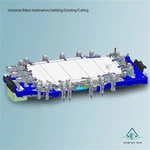
Welding Fixture
Why Choose Us
Product Application
Our products are mainly used for the welding, grinding, and cutting needs of various fields, including automobiles and auto parts, aerospace, ships, petrochemicals, pipelines and pressure vessels, engineering machinery, mining equipment, two and three-wheel vehicle manufacturing, sheet metal, sports equipment manufacturing, medical device manufacturing, metal furniture manufacturing, and rail transit.
Our Company
Changzhou Anchuang Intelligent Equipment Co., Ltd. is an intelligent equipment industry and trade integration company focusing on the application of industrial robot automated welding, grinding, and cutting technologies. The company provides customers with the most professional R&D, production, sales, training, and after-sales services. The headquarters is located in Changzhou, Jiangsu, China. The company’s mission is to provide efficient, accurate, and reliable robotic solutions for the manufacturing industry, and truly realize the automated and intelligent upgrade of manufacturing for global customers.
Our Services
We provide professional consulting services: Anchuang offers customers information consultation on products, prices, technologies, and industry solutions through the Internet, telephone, email, and door-to-door services.
Our Certificates
Our certifications include high-tech enterprise certificates, high-tech product certification certificates, quality management system certification certificates, corporate credit evaluation certificates, industry-university-research-school-enterprise cooperation certificates, patent certificates, and more.
What is Welding Fixture?
A welding fixture is a device or tool that is used to hold, position, and locate workpieces during the welding process. Welding fixtures are designed to ensure that the workpieces are held securely in the correct position and orientation, so that the welds are made accurately and consistently.


Types of Welding Fixture
Gas Welding Fixtures
Welding is done by burning fuel in the presence of oxygen which produces extremely high temperatures that melt the parts and join them during welding. In the case of gas welding, the heat loss should be minimum to avoid weld cracks. Hence fixtures should be designed in such a way that large fixture masses are located away from the weld line while providing enough support to the workpieces.
Special care is required while welding copper and aluminium due to excessive heat loss from the materials. To address this difficulty, tack welding has to be done on the points away from the fixture contact points and the rest of the welding is done out of fixtures. C-clamps and hold down plates are additionally used to support the workpiece and prevent weld distortions.
Arc Welding Fixtures
The workpiece can react chemically with oxygen and nitrogen gases from the air at higher temperatures produced by the arc while welding. To prevent the part from reacting with air, a protective shielding gas is used around the welding area to minimise the exposure of the workpiece to the surroundings.
The temperatures produced in arc welding are much higher than those in gas welding. Hence they are used in welding steel structures and vehicles. More heat is generated at the weld line in arc welding than that of gas welding. Therefore the fixture, in this case, should provide good support, proper alignment to the workpiece and also allow heat dissipation from the weld area.
Resistance Welding Fixtures
The fixtures must be free of debris and flash for safe operation. There are various reasons for healing up of the fixture like inductance, insulation, weld flash and location. Even magnetic tooling causes similar issues. The tool absorbs energy and heats up during welding which forces the welder to work harder for spot welding. To avoid this, fixtures, base plates and other components are made from non-magnetic materials.
Insulate fixture to prevent current flowing through it and heating up due to resistance heating. From bolts to mating surfaces, insulate all the components of the fixture.
Laser Welding Fixtures
Laser welding is known for its versatility and quickness in producing narrow, deep welds with a minimum distortion and heat input. It has gained much popularity among the parts that require little to no-post weld processing. Also, laser welding with a proper fixture eases the tool work, results in a precise product in less time.
Assembly fixtures
These fixtures support the correct assembly of components and products. The fixture design positions and holds parts during assembly, ensuring that the part accurately fits and functions properly. For assembly fixtures, the benefits of fixturing include increased assembly speed, accuracy, less errors, and improved productivity. Assembly fixtures are typically used in industries such as automotive, appliance production, electronics, and aerospace.
Inspection fixtures
The fixturing applications for inspection fixtures include specific equipment or tools that are utilized in quality control to position and hold workpieces in place. Most commonly used with a CMM, or coordinate measuring machine, inspection fixtures lead to better accuracy, repeatability, and efficiency during inspection. Inspection fixtures are used in aerospace, electronics, automotive, and precision manufacturing.
Marking fixtures
These fixtures are implemented in manufacturing processes to create accurate and consistent marking on workpieces. Marking fixtures enhance the quality, efficiency, and repeatability of the marking, which may include branding, serial numbers, product labeling, barcodes, or part identification. Specifically, laser marking uses a laser beam to make precise and permanent marks on different materials. The aerospace, electronics, automotive, and metalworking industries utilize marking fixtures.
Welding fixtures
They are tools or equipment used in the welding processes to hold and position workpieces during welding. These fixtures stabilize the workpiece so the proper alignment can be achieved which results in accurate welding. The benefits of fixturing include improving weld quality, repeatability, and productivity. Welding fixtures are used in automotive, aerospace, construction, and metal fabrication.
For high production or complex objects fixturing, some additional arrangements are required when compared to simple fixturing.
Something that can quickly get fixed into the fixture and establish a firm holding to the parts to be welded is necessary.
While welding parts of different dimensions, setup blocks are advantageous over the landing method of locating.
These setup blocks are interchangeable to accommodate various types of workpieces.
Some other locators like dowel pins, adjustable, spring plungers etc for locating different work parts.
The mainframe of the fixture should be strong so that the deflection of the fixture caused by operations and clamping should be as minimum as possible. The frame should be massive enough to withstand vibration and chatter during the processes.
Frames of the fixtures are fastened with screws or welded in case of a permanent joint. If we require frequent changing of parts, the frames are fastened with screws. If the body of the fixture has a complex shape, then it can be manufactured from cast iron.
Clamps are chosen such that they can be accommodated quickly with minimum effort.
All the locators should be completely visible to the operator and accessible for cleaning.
The surface area of contact should be as small as possible to avoid causing damage to the workplace due to clamping or workforces.
The workpiece should be held firm using 3 or more support points depending on the type of the workpiece. Also, these support points should circumscribe the centre of gravity of the workpiece.
The use of welding fixtures can increase the output of workpieces
After using the welding fixture, a lot of auxiliary work (such as scribing, aligning, measuring, point fixing, turning the workpiece, etc.) can be saved. Different weldments may require different auxiliary times. Proper use of welding assembly jig and fixture can generally reduce auxiliary hours by 50-90% and increase throughput.
The use of welding fixtures can improve the quality of the workpiece
A weldment is welded in a free state and generally deforms after welding. If it exceeds the technical requirements, it will affect the subsequent assembly work, or affect the future work performance of the product. Make full use of the welding fixture to accurately position and firmly clamp the weldment. Its deformation during welding is limited. If supplemented by anti-deformation measures, the weldment after welding can meet the shape and size required by the product drawing. Especially for those weldments that require high dimensional accuracy, the technical requirements cannot be met without the use of welding fixtures from a professional cnc parts supplier.
The use of welding fixtures can expand the working range of the automatic welding machine
A high-efficiency submerged arc automatic welding machine can only weld straight line welds in the flat welding position if there is no welding jig or mold to cooperate with it. If a set of roller runners is designed, it can weld girth welds on cylindrical weldments. The welding positioner can also adjust the fillet welds in various positions to the boat-shaped position, and the welding head welds it just like it is in the flat welding position. This expands the application range of automatic welding machines and gives full play to the potential of automatic welding machines.
The use of welding fixtures can improve working conditions
Manual assembly is labor-intensive, and it is impossible and unsafe to flip the workpiece manually during welding. The use of lightweight and flexible welding fixtures or welding molds with a high degree of automation to replace manual positioning, clamping, and turning the workpiece significantly improves the labor conditions of workers.
The use of welding fixture can be good economic benefits
Although the cnc machine electrical parts production of welding fixtures will increase the cost of the enterprise, the main factors that determine the cost of the product are: raw material consumption, labor consumption and equipment investment costs. Once the welding jig is in action, it can reduce the consumption of assembly and welding man-hours, thereby increasing the output.
Components of Welding Fixtures
Welding fixtures are composed of various components that work together to ensure the proper positioning and holding of the workpiece. Let’s take a closer look at some of these components
Base frame
The base frame serves as the foundation of the fixture, providing stability and support for the positioning system and workpiece.
Clamping mechanisms
Clamping mechanisms are designed to secure the workpiece in place during welding operations. They can range from manual clamping using handle clamps to more advanced pneumatic clamping for automation purposes.
Accessory pieces
Accessory pieces are additional components added to the fixture to support specific workpiece requirements. This can include mechanisms for maintaining runout on collars, small part holders, or specialized clamps to accommodate unique workpiece shapes or sizes.
Zero frame or origin point
The zero frame or origin point is an essential component that helps establish the reference point for positioning the workpiece. It assists in maintaining consistency and accuracy throughout the welding process.

Welding Fixtures Design Tips
A fixture is only as good as its design. Here are a few tips to keep in mind when designing your welding fixture:
A good welding fixture ensures secure and stable positioning of the product during welding, while also allowing for easy removal after welding.
Take into account the heat effects of the welding process on the finished part.
Fabricate fixtures with removable stops and easy-to-replace parts so that you do not have to replace the entire fixture when certain areas wear out.
Design your fixtures with the welding robot in mind. They have specific ranges of movement, and the fixture must be designed to accommodate these limitations.
To prevent arcing and potential damage to the fixture or robot, it is important to properly ground the fixture.
Design your fixtures with safety in mind. They should create a safer environment and be easy to use.
Applications of Welding Fixture
In aerospace, precision and reliability are paramount. Modular welding fixtures are used to fabricate critical components such as aircraft frames, landing gear, and engine parts.
The automotive industry relies heavily on modular welding fixtures for assembling vehicles’ chassis and body structures. These fixtures enable automakers to consistently produce cars with tight tolerances, ensuring safety and quality.
Shipbuilders employ modular welding fixtures to construct the hulls and superstructures of vessels. These fixtures provide a stable platform for welders to work on, ensuring the ship’s structural integrity.
Modular fixtures are great options for welders who can’t accommodate various specialized fixtures in their workspace. With modular fixtures, you can efficiently handle diverse welding requirements without taking up excessive space.
Engineers and researchers utilize modular welding fixtures during the prototyping and testing phases of product development. With these fixtures, you can rapidly create prototypes for various industries. According to the National Conference on Recent Trends in Engineering & Technology, modular welding fixtures can be used for prototyping and temporary replacement.

Factors to Consider When Choosing a Welding Fixture
Size and Weight of Workpiece
The dimensions and weight of your workpiece play a crucial role in fixture selection. The fixture must be robust enough to support and securely hold the workpiece during welding without deformation or misalignment. It should also be adjustable to accommodate various workpiece sizes if your projects vary in scale.
Welding Process
The welding method you’ll be using is another critical factor. Most fixtures are designed to support specific welding processes, like MIG welding, stick welding, or TIG welding process. It should provide easy access to the welding area and ensure proper electrode or torch positioning. If you want one solution for various welding processes, a modular welding fixture will work best.
Clamping Mechanism
The clamping mechanism is another considerable factor in choosing a welding fixture. It should securely hold the workpiece in place without damaging it. Look for fixtures with adjustable clamps or fixtures that can accommodate a variety of workpiece shapes and sizes.
Safety Features
Safety should always be a top priority while working on a welding project. Make sure your welding fixture comes with safety features, such as heat shields or guards. These features protect you from sparks, spatter, and harmful fumes. You should also maintain ventilation during welding.
Maintenance and Durability
Durability and maintenance are key features of a welding fixture. Invest in a fixture that is made of durable material and resists rigorous usage. Moreover, pay attention to maintenance requirements. An easy-to-maintain fixture can save you time, allowing you to focus on other tasks.
Certifications

It is an intelligent equipment industry and trade integration company focusing on the application of industrial robot automated welding/grinding/cutting technologies. The company provides customers with the most professional R&D, production, sales, training and after-sales services. The headquarters is located in Changzhou, Jiangsu, China. The company's mission is to provide efficient, accurate and reliable robotic solutions for the manufacturing industry, and truly realize the automated and intelligent upgrade of manufacturing for global customers.
FAQ
Q: What is Welding Fixture?
Q: Which is the important factor to determine the construction of fixture?
Q: What is the procedure for fixture design?
Q: What are the different types of welding fixtures?
Q: What is the 3-2-1 principle of fixture design?
Q: What are the three tests of a fixture?
Q: What are the advantages of welding fixtures?
Q: Why are jigs and fixtures used in welding?
Q: What is the best material for welding fixtures?
Another important aspect of setting up spot welding fixtures is choosing the right materials. Spot welding fixtures are typically made of copper or brass because these materials are good conductors of electricity and can withstand high temperatures.
Q: What is the difference between a jig and a fixture in welding?
Q: What is the basic principle of fixture design?
Q: Why are welding fixtures important?
Q: What is the main function of welding fixture?
Q: What Are Common Examples of Fixtures?
Q: What Is the Most Common Type of Fixture?
Q: What are the considerations while designing a welding fixture?
Q: What is the basic of welding fixture?
Q: What is the main function of welding fixtures?
Q: What is the application of welding fixture?
Q: What Are Jigs and Fixtures in Welding?