



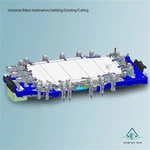
Polishing Robot
Why Choose Us
Product Application
Our products are mainly used for the welding, grinding, and cutting needs of various fields, including automobiles and auto parts, aerospace, ships, petrochemicals, pipelines and pressure vessels, engineering machinery, mining equipment, two and three-wheel vehicle manufacturing, sheet metal, sports equipment manufacturing, medical device manufacturing, metal furniture manufacturing, and rail transit.
Our Company
Changzhou Anchuang Intelligent Equipment Co., Ltd. is an intelligent equipment industry and trade integration company focusing on the application of industrial robot automated welding, grinding, and cutting technologies. The company provides customers with the most professional R&D, production, sales, training, and after-sales services. The headquarters is located in Changzhou, Jiangsu, China. The company’s mission is to provide efficient, accurate, and reliable robotic solutions for the manufacturing industry, and truly realize the automated and intelligent upgrade of manufacturing for global customers.
Our Services
We provide professional consulting services: Anchuang offers customers information consultation on products, prices, technologies, and industry solutions through the Internet, telephone, email, and door-to-door services.
Our Certificates
Our certifications include high-tech enterprise certificates, high-tech product certification certificates, quality management system certification certificates, corporate credit evaluation certificates, industry-university-research-school-enterprise cooperation certificates, patent certificates, and more.
What is Polishing Robot?
Polishing robots come in many shapes and sizes depending on their application, but the typical application will use a Six-Axis robotic arm, equipped with an end-effector to hold the polishing pad and apply pressure. Electrically-actuated motors within the robot are then used to create the appropriate polishing pattern, be it spinning or oscillating.
The key to Polishing robots is that they can achieve a consistent, uniform finish over a large surface area in a fraction of the time it would take human workers to do the same job. They are ideal for high-volume production and can produce flawless results for items like automobile parts, fine parts, and consumer electronics.


Benefits Of Polishing Robot
Consistency
The Robot Polishing Machine can maintain consistent pressure and speed throughout the polishing process, resulting in a uniform finish.
Efficiency
These machines can work continuously without fatigue, increasing productivity.
Safety
By automating the polishing process, these machines reduce the risk of workplace injuries associated with manual polishing.
Flexibility
The Robot Polishing Machine can be programmed to polish a variety of materials and shapes, making it a versatile tool for surface treatment.
Polishing robot applications in various industries
Polishing robots are versatile and have applications across many major industries. Their consistent, automated polishing capabilities provide benefits for manufacturers of all types.
Automotive industry
Automakers utilize Polishing robots to buff and shine vehicle bodies, wheels, and other components. Robots can polish multiple vehicles or parts simultaneously with a high degree of precision and consistency. This reduces manual labor needs, decreases cycle times, and improves quality, which is particularly important in the brand-driven automotive industry.
Aerospace industry
Aerospace manufacturers deploy Polishing robots to refine the surfaces of aircraft, spacecraft, and satellites. Robots are well-suited for polishing large, curved surfaces to an ultra-smooth finish, common in the aerospace industry. They can also access tight spaces and polish components of varying geometries. Robot polishing helps aerospace companies achieve the exacting surface standards required for their products. Often, getting aerodynamics and tolerances just right requires a level of precision only robots can provide.
Medical device industry
Producers of medical equipment, surgical tools, and implants use Polishing robots to finish and sterilize components. Robotic polishing, paired with techniques like electropolishing, helps achieve the sterile, ultra-smooth surfaces necessary for medical applications. Automated polishing also reduces risks of contamination that could arise from manual polishing methods.
Implementing Polishing robots: What you need to know
Choosing the right robot
The first step is selecting a robot that suits your needs. Consider:
Type of polishing required - surface, edge or profile polishing. You’ll need to choose the right end-effector.
Size and shape of parts - robots come in different sizes and reach specifications. Make sure the robot can handle the dimensions of your parts.
Production volume - robots differ in speed, accuracy and repeatability. Choose one that matches your throughput requirements.
Ease of programming - some robots are easier to program for different parts and polishing operations. Look for a robot with intuitive programming that minimizes downtime and the need for programming specialists.
Integrating the robot
Next, you’ll need to integrate the robot into your production line. This includes:
Providing a stable base - the robot needs a sturdy platform or frame to operate from. This may require floor reinforcement.
Supplying utilities - including power, compressed air, water cooling, exhaust ventilation, etc. depending on your polishing needs. Remember, in many cases, the robot arm and the end-effector may be powered separately.
Programming the robot - either using the robot's handheld teach pendant or offline programming software. Program the robot with the proper polishing paths, speeds, and pressures for your parts.
Fixturing parts - you'll need custom part fixtures to hold the parts in place during polishing. The robot should be able to load and unload parts from the fixtures automatically.
Top Tip: Find a manufacturer or distributor who specializes in solutions engineering. The ideal partner will help you figure out the full solution for your needs (including the robot, end-effector(s) and accessories), take care of installation and programming and even provide an aftercare maintenance and support service.
Safety considerations
Don't forget safety! When implementing Polishing robots, be sure to:
Install proper safeguarding - if you don’t have a collaborative robot, then this may include light curtains, safety scanners, emergency stops, protective barriers, etc. to protect workers from the moving robot.
Ground parts and fixtures - to prevent electric shocks from built-up static charges during polishing.
Provide ventilation - for any polishing compounds, coolants or debris to disperse.
Train workers - anyone interacting with the robot needs proper training on safe operation, loading/unloading, programming and maintenance procedures. Make sure your team knows what to expect from the robot.
Following these steps will help ensure a smooth transition to automated Polishing robots in your factory. While the initial investment may seem high, the long term benefits to quality, consistency and productivity will make it worthwhile.
Maintaining your robotic Polishing system
Daily checks
Perform a quick inspection of the robot and work area before starting each shift. Check that all cables and hoses are securely connected and not damaged. Ensure the polishing pads are clean and not worn down. Vacuum the robot and surrounding area to remove any debris. In most cases, a robot won’t be able to sense an issue with its preparation and can easily damage each part it touches before someone on your team notices.
Lubricate joints
While lubrication is a typical maintenance task for most machines, robots are particularly sensitive to the lubrication of their joints. Slight over-or-under application of lubricant can cause joints to move faster or slower than they should, leading to imprecise polishing and potentially adding seconds to every cycle. Your manufacturer will provide a recommended lubrication schedule.
Software updates
Software updates may provide new features, tighter security, and bug fixes. In general, it’s best practice to update robot software every three to six months to take advantage of the latest improvements. Follow the instructions carefully when performing an update to avoid issues and always backup your current software configuration first in case you need to roll back.
Start with the basics
Focus on simple movements and tasks before moving on to more complex polishing procedures. Have the robot move smoothly from point A to point B, then work on changing directions and speeds. Take it slow — rushing into complicated programs will only lead to mistakes and frustration.
Simulate the program before running it
Double-check that your automation is error-free by simulating how the robot will move using the programming software. Look for any potential issues like collisions, inefficient movements, or logic errors before testing it out on the actual robot.
Be extremely specific in your programming
You need to explicitly tell the robot every step, direction, speed, and action required to complete the task. Measure, map out, and include precise coordinates, angles, pressures, and dwell times. It may feel tedious but thorough programming is key.
Don’t forget the importance of force
Unlike humans, robots will not vary their use of force when polishing without explicit programming. Look for a force sensor that integrates with your robot and allows you to program explicit, precise levels of force and torque control while your robot polishes.
Expect mistakes and make adjustments
No matter how well you've programmed your robot, issues will arise. Parts may be slightly off in size or position, abrasives may wear down differently than anticipated, and adjust your programming accordingly. With regular use and updates, you'll get better and better at achieving perfect surface finishes.
The Essentials of Installation Process Polishing Robot
Location: Consider the space and location within your workplace, ensuring there’s ample room for movement during polishing operations.
Power Supply: Confirm that your facility has reliable power sources able to sustain the system’s load without causing interruptions in other areas of operation.
Connectivity Requirements: Many robotic systems rely on network connectivity for maximum functionality. Having a robust network infrastructure is crucial.
Training: Does the supplier provide training to operators following installation? Understanding how to run the machine safely and efficiently helps avoid unexpected breakdowns or accidents. This may be required as part of your broader on-site safety training efforts.
How to Choose Polishing Robot
Size and Capacity
The size and capacity of the polishing machine will depend on the size of the objects you need to polish. If you work with small items like jewelry, a compact machine with a small polishing head may be sufficient. However, if you deal with larger objects like car parts, you will need a machine with a larger polishing area.
Speed and Power
The speed and power of the machine will determine how quickly and effectively it can polish the surface. Higher speeds and greater power are generally preferred for achieving a smooth and shiny finish. However, it is important to ensure that the machine offers adjustable settings to accommodate different materials and polishing requirements.
Flexibility and Versatility
Some polishing machines are designed specifically for a particular type of material or surface. However, if you work with a variety of materials, it is best to choose a machine that offers flexibility and versatility. Look for machines that come with interchangeable polishing heads or adjustable settings to accommodate different materials.
Quality and Durability
Investing in a high-quality and durable polishing machine is essential for long-term use. Look for machines made from sturdy materials that can withstand continuous use and provide reliable performance. Reading customer reviews and checking the warranty can also help you gauge the quality and durability of the machine.
Certifications

It is an intelligent equipment industry and trade integration company focusing on the application of industrial robot automated welding/grinding/cutting technologies. The company provides customers with the most professional R&D, production, sales, training and after-sales services. The headquarters is located in Changzhou, Jiangsu, China. The company's mission is to provide efficient, accurate and reliable robotic solutions for the manufacturing industry, and truly realize the automated and intelligent upgrade of manufacturing for global customers.
FAQ
Q: What is the current state of the Polishing Robots market?
Q: Who are the key players in the Polishing Robots market?
Q: What factors are driving the growth of the Polishing Robots market?
Q: Are there any challenges affecting the Polishing Robots market?
Q: How is the competitive landscape in the Polishing Robots market?
Q: What are the key trends shaping the Polishing Robots market?
Q: How is the Polishing Robots market segmented?
Q: What growth opportunities exist in the Polishing Robots market?
Q: How can businesses enter the Polishing Robots market successfully?
Q: What are the future prospects for the Polishing Robots market?
Q: What is Polishing Robot?
Q: What are the preventive maintenance for industrial robots?
Q: How often do robots need maintenance?
By maintaining a regular preventive maintenance schedule, you are extending the life of your robot exponentially. The different leading brands in robotics recommend scheduling preventive maintenance every 12 months, others are based on their working hours. It is considered convenient to do it after 10,000 hours.
Q: Can a robot repair itself?
Q: What keeps a robot running?
Q: Do robots need electricity to work?
Q: What do all robots need?
Q: What is a robot made of?
Q: How many systems does a robot have?
There are three types of robotic systems – the manipulation robotic system, the mobile robotic system and the data acquisition and control robotic system.
Q: What controls a robot?