

In the realm of industrial manufacturing, the four - axis positioner has emerged as a crucial tool for enhancing productivity and precision. As a supplier of four - axis positioners, I have witnessed firsthand how these devices can adapt to a wide range of workpieces. This blog post will delve into the various ways in which a four - axis positioner can be tailored to different workpieces, exploring the technical features and practical applications that make it a versatile solution.
Understanding the Four - Axis Positioner
A four - axis positioner typically consists of four independent axes of motion: rotation, tilt, swivel, and linear movement. These axes work in tandem to provide a high degree of flexibility in positioning workpieces. The rotation axis allows the workpiece to spin around a central point, while the tilt axis enables it to be inclined at different angles. The swivel axis provides lateral movement, and the linear axis allows for forward and backward motion.
Adapting to Different Workpiece Shapes
One of the key challenges in manufacturing is dealing with workpieces of various shapes. A four - axis positioner can easily adapt to different geometries. For example, for cylindrical workpieces, the rotation axis can be used to rotate the cylinder continuously, allowing for uniform processing such as welding or machining around the circumference. The tilt axis can be adjusted to position the cylinder at the optimal angle for the operation.
For irregularly shaped workpieces, the combination of all four axes can be used to achieve the desired orientation. The swivel and linear axes can be used to move the workpiece into the correct position, while the rotation and tilt axes can be adjusted to present the appropriate surface for processing. This flexibility ensures that even complex workpieces can be handled efficiently.
Handling Different Workpiece Sizes
Workpieces come in a wide range of sizes, from small components to large structures. A four - axis positioner can be designed to accommodate different sizes. For small workpieces, a compact positioner with high precision can be used. These positioners often have a smaller footprint and can be easily integrated into a production line.
On the other hand, for large workpieces, a heavy - duty four - axis positioner is required. These positioners are built with robust structures and powerful motors to handle the weight and size of the workpiece. They can be used in industries such as shipbuilding, where large steel structures need to be welded or machined.
Customizing for Specific Workpiece Requirements
In addition to adapting to different shapes and sizes, a four - axis positioner can be customized to meet specific workpiece requirements. For example, in the aerospace industry, where precision is of utmost importance, the positioner can be equipped with high - accuracy sensors and control systems. These sensors can provide real - time feedback on the position and orientation of the workpiece, ensuring that the processing is carried out with the highest level of precision.
Another example is in the automotive industry, where workpieces often need to be processed at high speeds. A four - axis positioner can be optimized for high - speed operation, with fast - acting motors and smooth - running mechanisms. This allows for efficient production and reduces the overall processing time.
The Role of Automation
Automation plays a significant role in the adaptation of four - axis positioners to different workpieces. With the use of programmable logic controllers (PLCs) and computer - numerical control (CNC) systems, the positioner can be programmed to perform complex movements and operations. This not only increases the efficiency of the production process but also reduces the risk of human error.
For example, a pre - programmed four - axis positioner can automatically adjust the position and orientation of the workpiece based on the specific requirements of the operation. This is particularly useful in mass production, where the same workpiece needs to be processed repeatedly.

Practical Applications
The versatility of four - axis positioners makes them suitable for a wide range of applications. In the welding industry, they are used to position workpieces at the optimal angle for welding, ensuring high - quality welds. In the machining industry, they can be used to hold workpieces securely during milling, drilling, and turning operations.
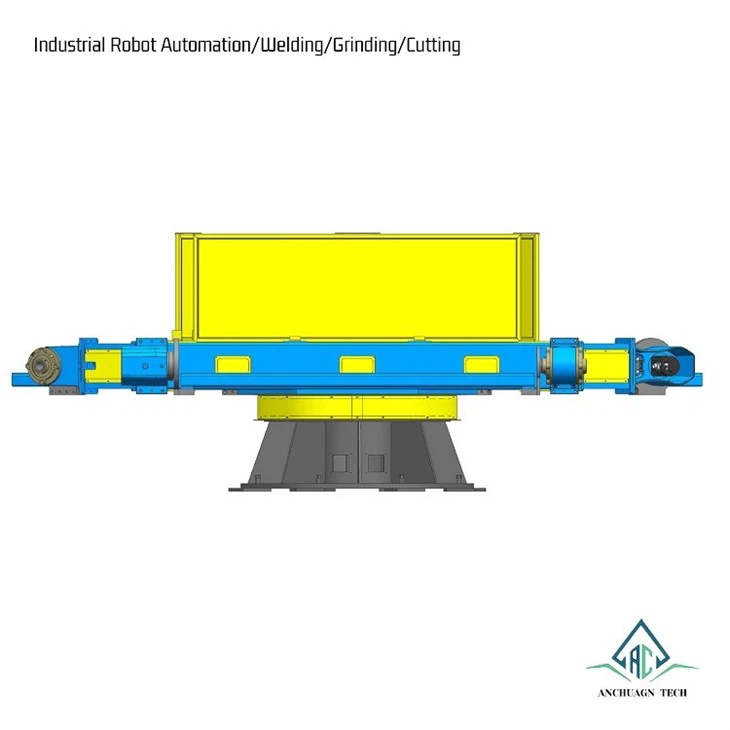
One notable type of four - axis positioner is the Four - axis Rotating Three - station Flip Positioner. This positioner offers three stations, which can be rotated and flipped to provide continuous processing. It is particularly useful in high - volume production environments, where the ability to quickly change workpieces is essential.
Conclusion
In conclusion, a four - axis positioner is a highly adaptable tool that can meet the needs of different workpieces. Its ability to handle various shapes, sizes, and specific requirements makes it an invaluable asset in the industrial manufacturing sector. Whether it is for small - scale production or large - scale mass production, a four - axis positioner can significantly improve productivity and precision.
If you are interested in exploring how our four - axis positioners can adapt to your specific workpiece requirements, we invite you to contact us for a purchase consultation. Our team of experts is ready to assist you in finding the best solution for your manufacturing needs.
References
- Smith, J. (2018). Industrial Positioning Systems: A Comprehensive Guide. Publisher X.
- Brown, A. (2019). Advances in Four - Axis Positioner Technology. Journal of Manufacturing Technology, 25(3), 123 - 135.


