

How to Measure the Performance of a Cobot Welding Cell?
As a supplier of Cobot Welding Cells, I understand the significance of accurately measuring the performance of these advanced systems. In today's competitive manufacturing landscape, the efficiency, quality, and productivity of a cobot welding cell can make a substantial difference in a company's bottom line. This blog post aims to explore the key metrics and methods for evaluating the performance of a cobot welding cell.
1. Welding Quality
Welding quality is perhaps the most critical aspect of a cobot welding cell's performance. It directly impacts the strength, durability, and appearance of the welded products. Several factors contribute to welding quality, and measuring them is essential for ensuring consistent results.
- Penetration and Fusion: Adequate penetration and fusion are crucial for creating strong welds. Penetration refers to the depth to which the weld metal penetrates the base metal, while fusion is the complete melting and mixing of the weld and base metals. Non - destructive testing methods such as ultrasonic testing (UT) and radiographic testing (RT) can be used to assess the penetration and fusion of the welds. These tests can detect internal defects such as lack of fusion, porosity, and cracks.
- Weld Bead Geometry: The shape and size of the weld bead also play a significant role in welding quality. Parameters such as bead width, height, and reinforcement should be within the specified tolerances. Visual inspection and measurement tools like calipers and gauges can be used to evaluate the weld bead geometry.
- Weld Defects: The presence of weld defects, such as porosity, cracks, and inclusions, can significantly reduce the strength and integrity of the welds. Regular inspection using visual inspection, magnetic particle inspection (MPI), or liquid penetrant inspection (LPI) can help detect these defects early and take corrective actions.
2. Productivity
Productivity is another important metric for measuring the performance of a cobot welding cell. It is typically measured in terms of the number of parts welded per unit of time or the cycle time per weld.
- Cycle Time: Cycle time is the time required to complete one welding operation, including loading and unloading the parts, positioning the cobot, and performing the weld. Reducing cycle time can increase the overall productivity of the welding cell. Factors that can affect cycle time include the speed of the cobot, the complexity of the welding task, and the efficiency of the part handling system.
- Throughput: Throughput is the number of parts that can be welded in a given period. It is calculated by dividing the total number of parts welded by the total time taken. Increasing throughput can be achieved by optimizing the welding process, improving the cobot's programming, and reducing downtime.
- OEE (Overall Equipment Effectiveness): OEE is a comprehensive metric that takes into account availability, performance, and quality. Availability refers to the percentage of time the welding cell is available for production, performance is the ratio of the actual production rate to the maximum possible production rate, and quality is the percentage of good parts produced. A high OEE indicates that the welding cell is operating efficiently and effectively.
3. Safety
Safety is a top priority in any manufacturing environment, and cobot welding cells are no exception. Measuring the safety performance of a cobot welding cell involves assessing the effectiveness of safety features and procedures.
- Safety Features: Cobot welding cells are equipped with various safety features, such as safety sensors, emergency stop buttons, and protective barriers. These features are designed to prevent accidents and protect the operators. Regular inspection and testing of these safety features are essential to ensure their proper functioning.
- Operator Training: Proper operator training is crucial for ensuring the safe operation of a cobot welding cell. Operators should be trained on the use of the cobot, safety procedures, and emergency response. Measuring the effectiveness of operator training can be done through written tests, practical demonstrations, and on - the - job observations.
- Accident Rate: The accident rate is a direct measure of the safety performance of a cobot welding cell. A low accident rate indicates that the safety measures in place are effective. Tracking and analyzing accident data can help identify areas for improvement and implement corrective actions.
4. Flexibility
In today's dynamic manufacturing environment, flexibility is becoming increasingly important. A cobot welding cell should be able to adapt to different welding tasks, part geometries, and production volumes.
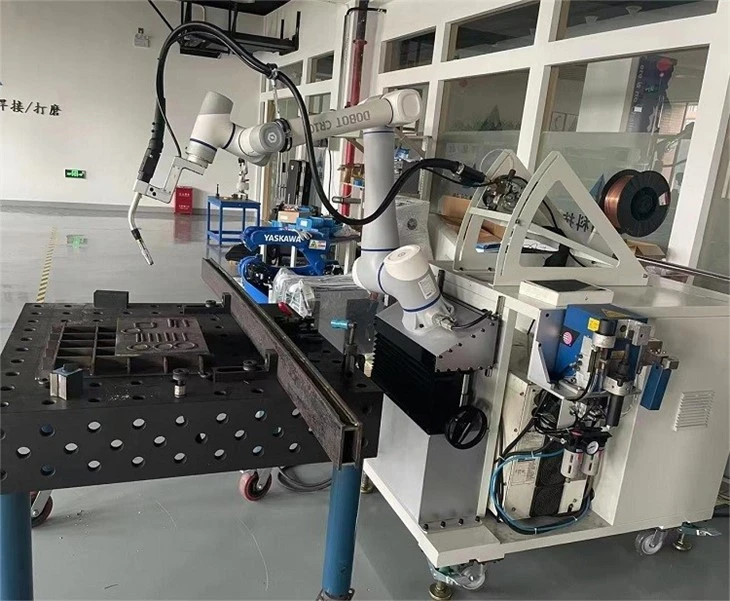

- Changeover Time: Changeover time is the time required to switch from one welding task to another. A short changeover time allows for greater flexibility and the ability to handle a variety of products. Factors that can affect changeover time include the ease of programming the cobot, the availability of tooling, and the efficiency of the part handling system.
- Compatibility with Different Parts: A cobot welding cell should be able to weld different types of parts with minimal reconfiguration. This requires a flexible programming system and the ability to use different welding processes and tools.
- Scalability: The ability to scale up or down the production capacity of a cobot welding cell is also an important aspect of flexibility. This can be achieved by adding or removing cobots, changing the part handling system, or adjusting the welding process.
5. Cost - Effectiveness
Cost - effectiveness is a key consideration for any manufacturing investment. Measuring the cost - effectiveness of a cobot welding cell involves evaluating the initial investment, operating costs, and return on investment (ROI).
- Initial Investment: The initial investment includes the cost of the cobot, welding equipment, tooling, and installation. Comparing the initial investment of different cobot welding cell options can help determine the most cost - effective solution.
- Operating Costs: Operating costs include energy consumption, maintenance, and consumables. Reducing operating costs can improve the cost - effectiveness of the welding cell. This can be achieved by using energy - efficient equipment, implementing preventive maintenance programs, and optimizing the use of consumables.
- ROI: ROI is calculated by dividing the net profit generated by the cobot welding cell by the initial investment. A high ROI indicates that the investment in the welding cell is paying off. Factors that can affect ROI include the productivity of the welding cell, the quality of the welds, and the cost savings achieved.
Our Cobot Welding Cell Offerings
At our company, we offer a range of cobot welding cell solutions to meet the diverse needs of our customers. Our Mobile Collaborative Welding Robot is designed for flexibility and ease of use, allowing for quick setup and reconfiguration. The Cobot Lifting Mobile Welding Unit is ideal for handling heavy parts and can be easily moved around the production floor. Our Heavy Platform Mobile Cobot Welding Cell provides a stable and robust platform for high - volume welding operations.
If you are interested in learning more about our cobot welding cell solutions or would like to discuss your specific requirements, we encourage you to contact us for a detailed consultation. Our team of experts is ready to assist you in selecting the right cobot welding cell for your application and ensuring its optimal performance.
References
- ASME Boiler and Pressure Vessel Code, Section IX - Welding and Brazing Qualifications
- ISO 15614 - 1:2017 - Specification and qualification of welding procedures for metallic materials - Welding procedure test
- AWS D1.1/D1.1M:2020 - Structural Welding Code - Steel


