Yo, what's up everyone! I'm a supplier of gantry trusses, and today I wanna talk about something super important: the temperature effects on gantry trusses.
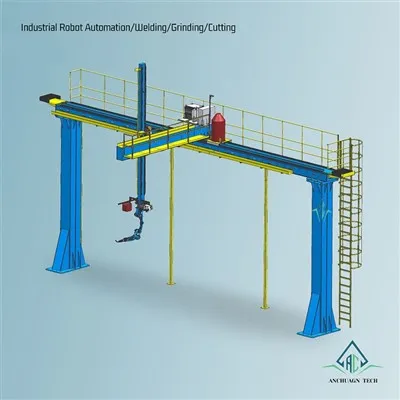
First off, let's understand what gantry trusses are. They're those cool structures that are used in a bunch of industrial applications. You can find them in manufacturing plants, warehouses, and even in some high - tech setups. We offer different types of gantry trusses, like the XYZ Three-axis Robot Gantry Truss, Dual Robot XY Axis Gantry Truss, and Single Robot XY Axis Gantry Truss.
Now, let's get into the temperature effects. Temperature can have a huge impact on gantry trusses, and it's not something to be taken lightly.
Thermal Expansion and Contraction
One of the most obvious effects of temperature on gantry trusses is thermal expansion and contraction. When the temperature rises, the materials that make up the gantry truss expand. Most metals, which are commonly used in gantry trusses, have a coefficient of thermal expansion. This means that as the temperature goes up, the length, width, and height of the truss increase.
For example, if you have a gantry truss made of steel and the temperature rises by 20 degrees Celsius, the truss will expand. This expansion can cause problems if the truss is not designed to accommodate it. If the truss is fixed at both ends and there's no room for expansion, it can lead to internal stresses. These stresses can be so high that they cause the truss to warp, bend, or even break.
On the flip side, when the temperature drops, the truss contracts. This contraction can also create issues. If the truss is attached to other components in a rigid way, the contraction can cause the connections to loosen or fail.
Impact on Structural Integrity
The changes in temperature can also affect the structural integrity of the gantry truss. As the truss expands and contracts, the joints and connections are put under stress. Over time, this repeated stress can lead to fatigue. Fatigue is when the material weakens due to repeated loading and unloading.
For instance, if a gantry truss is in an environment where the temperature fluctuates a lot, say from very cold in the morning to very hot in the afternoon, the joints will experience a lot of stress. The bolts and welds that hold the truss together can start to crack or loosen. This can compromise the overall stability of the truss and make it unsafe to use.
Effects on Precision
In many industrial applications, gantry trusses are used for precise operations. For example, in a manufacturing plant, a gantry truss might be used to move a robotic arm with high precision. Temperature changes can throw off this precision.
When the truss expands or contracts, the position of the end - effector (the part of the robotic arm that does the actual work) can change. This means that the robot might not be able to perform its tasks accurately. If you're working on a project that requires millimeter - level precision, a small change in the truss dimensions due to temperature can be a big problem.
Mitigating Temperature Effects
So, what can we do to deal with these temperature effects? Well, there are a few strategies.
One way is to use materials with a low coefficient of thermal expansion. Some advanced alloys have a much lower expansion rate compared to traditional metals. By using these materials, we can reduce the amount of expansion and contraction that occurs with temperature changes.
Another strategy is to design the gantry truss with expansion joints. These joints allow the truss to expand and contract without creating excessive internal stresses. They act as a buffer, absorbing the changes in length caused by temperature variations.
We can also use temperature - control systems. In some industrial settings, it's possible to control the temperature of the environment where the gantry truss is located. By keeping the temperature stable, we can minimize the effects of thermal expansion and contraction.
Why Choose Our Gantry Trusses
As a gantry truss supplier, we take these temperature effects seriously. Our team of engineers designs our gantry trusses to withstand temperature variations. We use high - quality materials and advanced manufacturing techniques to ensure that our trusses are durable and reliable.
Whether you need an XYZ Three-axis Robot Gantry Truss for a complex robotic application or a Single Robot XY Axis Gantry Truss for a simpler task, we've got you covered.


If you're in the market for a gantry truss and want to learn more about how we can help you deal with temperature effects, don't hesitate to reach out. We're here to have a chat about your specific needs and find the best solution for you. Contact us to start the procurement process and let's work together to get the right gantry truss for your project.
References
- "Thermal Expansion in Structural Materials" - A textbook on material science that covers the basics of thermal expansion and its effects on structures.
- "Industrial Gantry Truss Design and Applications" - A research paper that discusses the design considerations for gantry trusses in industrial settings, including temperature effects.