

Hey there! As a supplier of four - axis positioners, I often get asked about the precision of these nifty machines in angular positioning. So, let's dive right in and break it down.
First off, what exactly is a four - axis positioner? Well, it's a device that allows for movement in four different axes, which gives it a high degree of flexibility when it comes to positioning workpieces. This is super useful in a variety of industries, like welding, machining, and assembly.
Now, onto the main question: what's the precision of a four - axis positioner in angular positioning? Precision in angular positioning refers to how accurately the positioner can move and hold a specific angle. It's a crucial factor because in many applications, even the slightest deviation in angle can lead to significant problems.
There are several factors that can affect the precision of a four - axis positioner. One of the main ones is the quality of the motors and drive systems. High - quality motors can provide more accurate and smooth movement, which directly impacts the angular precision. For example, servo motors are often used in high - precision positioners because they can be controlled very precisely, allowing for accurate angular positioning.
The mechanical design of the positioner also plays a big role. A well - designed positioner with low backlash in its gears and joints will have better precision. Backlash is the play or clearance between the moving parts, and if it's too large, it can cause inaccuracies in the angular position. Manufacturers need to pay close attention to the design and construction of the positioner to minimize backlash and ensure high precision.
Another factor is the control system. A sophisticated control system can compensate for any small errors in the mechanical components. It can continuously monitor the position of the positioner and make adjustments to keep the angle accurate. For instance, some control systems use feedback sensors to measure the actual angle and compare it to the desired angle. If there's a difference, the control system can make corrections in real - time.

Let's talk about the typical precision levels you can expect from a four - axis positioner. In general, high - end four - axis positioners can achieve angular positioning precision within a few arc - minutes. An arc - minute is 1/60th of a degree. That's pretty impressive, considering how small of an angle that is. However, the actual precision can vary depending on the specific model and its intended application.
For example, in a welding application, where precise positioning of the workpiece is crucial for a good weld, you'll want a positioner with high precision. A precision of around 1 - 2 arc - minutes might be required to ensure that the weld is of high quality. On the other hand, in some less critical applications, a lower precision, say around 5 - 10 arc - minutes, might be acceptable.
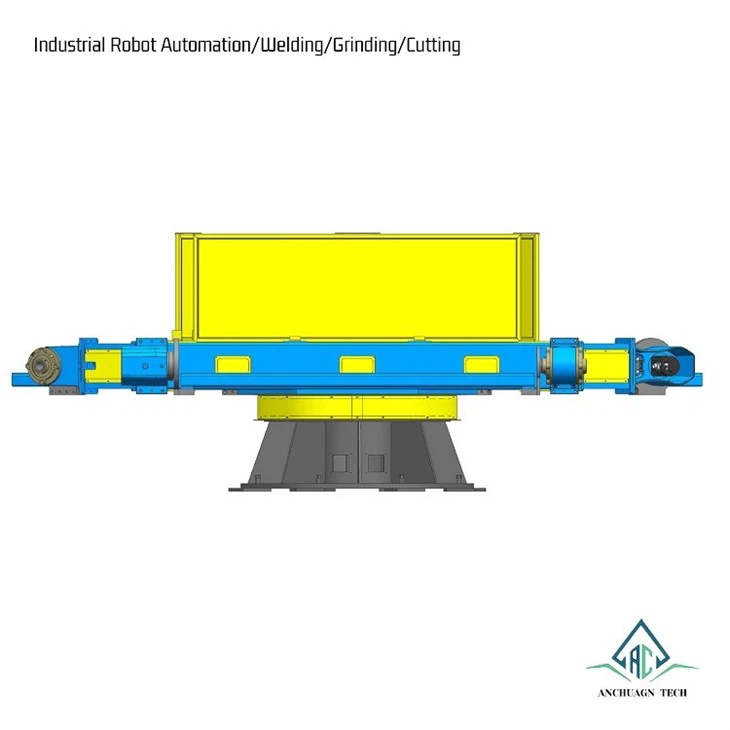
Now, I want to mention one of our awesome products, the Four - axis Rotating Three - station Flip Positioner. This positioner is designed with high - quality components and a state - of - the - art control system to provide excellent angular positioning precision. It's perfect for applications where you need to flip and rotate workpieces in multiple axes with high accuracy.
When it comes to choosing a four - axis positioner, it's important to consider your specific requirements. Think about the level of precision you need, the size and weight of the workpieces you'll be handling, and the environment in which the positioner will be used. If you need high precision, make sure to look for a positioner with high - quality motors, a well - designed mechanical structure, and a reliable control system.
In addition to precision, you also need to consider other factors like the speed of the positioner, its load capacity, and its ease of use. A positioner that's too slow might not be suitable for high - volume production, while one with a low load capacity won't be able to handle heavy workpieces. And if it's difficult to operate, it can lead to inefficiencies and errors.
If you're in the market for a four - axis positioner and want to discuss your specific needs, don't hesitate to reach out. We're here to help you find the perfect positioner for your application. Whether you're a small - scale workshop or a large - scale manufacturing plant, we have the expertise and products to meet your requirements.
To sum it up, the precision of a four - axis positioner in angular positioning is influenced by several factors, including the quality of the motors, the mechanical design, and the control system. High - end positioners can achieve very high precision, but the actual precision you need depends on your specific application. And if you're interested in our Four - axis Rotating Three - station Flip Positioner or any of our other products, just get in touch, and we'll have a great chat about your needs.
References:
- Industry standards and research on four - axis positioner technology
- Manufacturer's specifications and technical documentation for four - axis positioners


