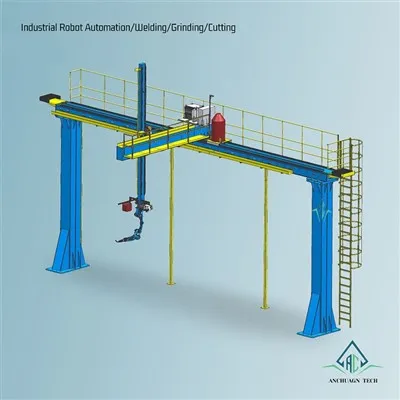
As a supplier of Dual Axis Positioners, I'm often asked about the inner workings of stepper motor drives in these devices. In this blog, I'll delve into the science behind how a stepper motor drive operates within a Dual Axis Positioner, exploring the principles, components, and benefits that make this technology so effective.
Understanding Stepper Motors and Their Role in Dual Axis Positioners
Stepper motors are a type of brushless DC electric motor that divides a full rotation into a number of equal steps. Unlike conventional motors that spin continuously, stepper motors move in discrete increments, allowing for precise control of position, speed, and torque. This makes them an ideal choice for applications like Dual Axis Positioners, which require accurate positioning and movement in two dimensions.
In a Dual Axis Positioner, stepper motors are used to control the rotation of the two axes - typically the horizontal (pan) and vertical (tilt) axes. By precisely controlling the movement of these motors, the positioner can accurately position a workpiece or tool in the desired orientation, enabling tasks such as welding, cutting, and inspection to be carried out with high precision.
How a Stepper Motor Drive Works
A stepper motor drive is an electronic device that controls the operation of a stepper motor. It provides the necessary electrical signals to the motor to move it in the desired direction and at the desired speed. The drive takes input from a control system, such as a microcontroller or a PLC (Programmable Logic Controller), and converts it into the appropriate electrical signals for the motor.
The basic components of a stepper motor drive include a power supply, a driver circuit, and a control interface. The power supply provides the electrical power needed to drive the motor. The driver circuit is responsible for generating the electrical signals that control the motor's movement. It typically consists of a series of transistors or MOSFETs (Metal-Oxide-Semiconductor Field-Effect Transistors) that switch the power to the motor's coils on and off in a specific sequence.
The control interface allows the drive to communicate with the control system. It can be a simple digital input/output interface or a more complex serial communication interface, such as RS-232 or CAN bus. The control system sends commands to the drive, specifying the desired position, speed, and direction of the motor, and the drive translates these commands into the appropriate electrical signals.
Stepper Motor Drive Modes
There are several different modes of operation for stepper motor drives, each offering different levels of performance and precision. The most common modes are full step, half step, and microstepping.
- Full Step Mode: In full step mode, the motor moves in full steps, with each step corresponding to a fixed angular displacement. This mode provides the highest torque but the lowest resolution.
- Half Step Mode: In half step mode, the motor moves in half steps, effectively doubling the resolution compared to full step mode. This mode offers a good balance between torque and resolution.
- Microstepping Mode: In microstepping mode, the motor moves in smaller fractions of a step, providing even higher resolution. This mode is ideal for applications that require very precise positioning, but it typically results in lower torque compared to full step and half step modes.
Benefits of Using Stepper Motor Drives in Dual Axis Positioners
The use of stepper motor drives in Dual Axis Positioners offers several benefits, including:
- Precise Positioning: Stepper motors provide precise control of position, allowing the positioner to accurately position the workpiece or tool in the desired orientation. This is essential for applications that require high precision, such as welding and cutting.
- Repeatable Movement: Stepper motors are highly repeatable, meaning that they can move to the same position repeatedly with a high degree of accuracy. This is important for applications that require consistent results, such as mass production.
- Simple Control: Stepper motor drives are relatively simple to control, making them easy to integrate into a control system. They can be controlled using a variety of methods, including digital inputs, analog signals, and serial communication.
- Cost-Effective: Stepper motors and drives are generally more cost-effective than other types of motors and drives, making them a popular choice for applications where cost is a factor.
Applications of Dual Axis Positioners with Stepper Motor Drives
Dual Axis Positioners with stepper motor drives are used in a wide range of applications, including:
- Welding: In welding applications, the positioner can be used to accurately position the workpiece in the desired orientation, allowing for more efficient and precise welding. Compact Dual-axis Positioner and C-type Tailstock Adjustable Dual-axis Positioner are popular choices for welding applications.
- Cutting: In cutting applications, the positioner can be used to hold the workpiece steady and position it accurately for cutting. This can improve the quality and accuracy of the cut.
- Inspection: In inspection applications, the positioner can be used to position the workpiece in the desired orientation for inspection. This can make it easier to detect defects and ensure quality control.
- Assembly: In assembly applications, the positioner can be used to hold the workpiece in the correct position for assembly, making the assembly process more efficient and accurate.
Conclusion
In conclusion, stepper motor drives play a crucial role in the operation of Dual Axis Positioners. By providing precise control of position, speed, and torque, they enable the positioner to accurately position the workpiece or tool in the desired orientation, making them an essential component in a wide range of applications.
If you're in the market for a Dual Axis Positioner, we offer a range of high-quality products, including the Compact Dual-axis Positioner, C-type Tailstock Adjustable Dual-axis Positioner, and Light Dual Axis Positioner. Our positioners are designed to provide reliable and precise performance, making them suitable for a variety of applications.


If you have any questions or would like to discuss your specific requirements, please don't hesitate to contact us. We'd be happy to help you find the right Dual Axis Positioner for your needs.
References
- Patterson, D. (2018). Stepper Motor Handbook. Elsevier.
- Boldea, I., & Nasar, S. A. (2015). Electric Drives: An Integrative Approach. CRC Press.